

How do you know if your child is ready for kindergarten? Does your child need a Kindergarten readiness assessment?
Starting kindergarten is a REALLY BIG milestone in a child’s life. Hey, in mom’s life, too, right? They still seem so little, but you know your tiny guy is ready for greater things. Well, you think so anyway…but are you sure?
How are you supposed to know? And are YOU ready?
What Does a Child Need to Know to be ready for kindergarten?
Well, when it comes to kindergarten readiness skills, the answer is actually: quite a lot. But don’t worry, your child has likely already learned most of it organically over the past five years.
Children are born learners! They come into the world ready to acquire new skills. Little children learn so fluidly and naturally, that what your child really does know may surprise you.
It’s pretty amazing to consider all that your child has learned since birth!

Kindergarten Readiness Checklist
Here’s a helpful kindergarten readiness checklist to give you a clear picture of what kids typically need to know before stepping into a kindergarten classroom:
Physical Development for Kindergarten Readiness
Gross Motor Skills
- Pedals a tricycle or bike with training wheels
- Hops on one foot
- Can carry a bowl or plate
- Swings
- Jumps, gallops, and jogs
- Attempts to catch or kick a ball
- Can participate in group games or songs (like Hokey Pokey)
- Attempts to keep rhythm
- Covers coughs & sneezes
- Knows how & when to wash hands
Fine Motor Skills
- Can shape playdough or clay
- Completes puzzles
- Can zip, button, and snap (maybe with help!)
- Strings beads
- Uses a fork and spoon
- Cuts with scissors
- Knows how to use glue
- Attempts to buckle seat belt
- Draws simple “egg” people
- Colors
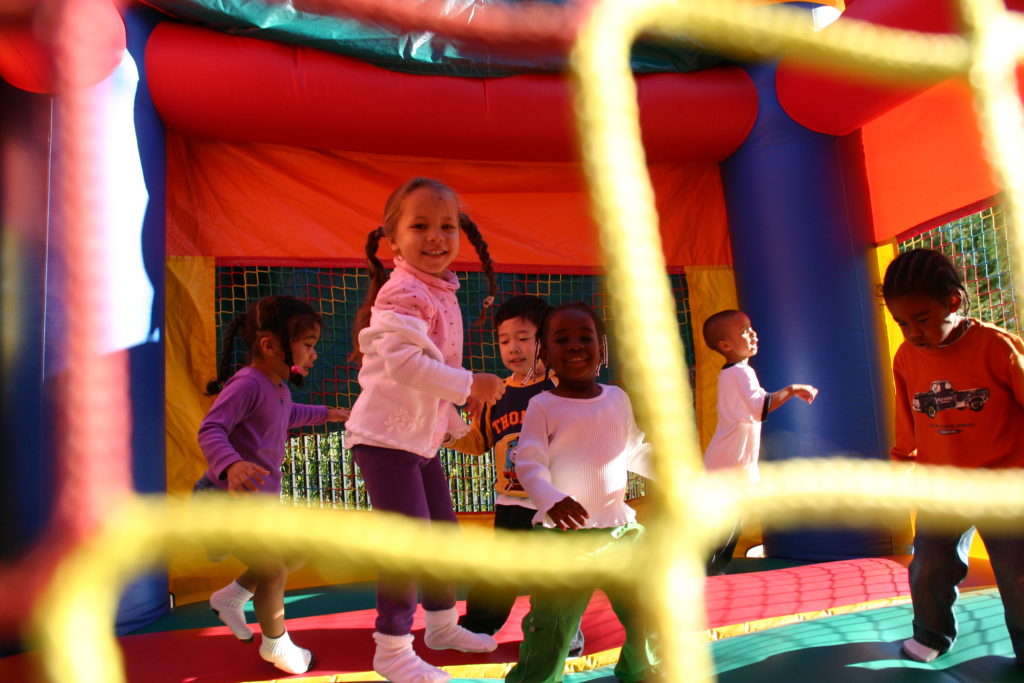
Social Skills for Kindergarten Readiness
- Knows how to share
- Knows how to be a friend
- Uses “please” and “thank-you”
- Answers questions when asked
- Respects personal boundaries
- Can interact within a group and seeks out interaction with others
- Knows own name, age, and gender
- Can say home address & phone number
- Knows parents’ names
- Shows self-awareness (can express needs, likes/dislikes, “I’m good at…”)
- Follows 2-3 step directions (like, “Please take your dish to the sink and then throw away your napkin.”)
- Tries to solve problems independently
- Can follow rules and routines (with reminders!)
- Takes care of belongings
- Respects authority & tries to behave well (most of the time!)
- Uses words to express feelings and emotions
- Can focus on an engaging task (play) for up to 20 minutes
- Uses verbal and non-verbal communication
- Speaks clearly enough that a stranger can understand
READ: Top 10 Social Emotional Picture Books for Kids
Academic Kindergarten Readiness Skills
Language & Literacy
- Understands 3,000-4,000 words
- Uses a strong vocabulary and complex sentences: can tell a simple narrative, answer questions, respond to others, describe objects, communicate feelings, needs, wants
- Participates in back-and-forth conversation
- Knows text has meaning
- Enjoys being read to & can tell back the story
- Recognizes rhyming words
- Can clap syllables
- Names at least 20 letters
- Knows at least 20 letter sounds
- Understands print direction (top to bottom and left to right)
- Holds a book correctly (not upside down)
Writing Skills
- Draws pictures
- Writes first name
- Attempts to copy letters
- Tries to scribble or write words (maybe strings of random letters)
- Attempts to write left to right on a straight horizontal line
Math Skills
- Counts to 30
- Counts 10 objects accurately, touching each one
- Uses ordinal numbers (1st, 2nd, 3rd, 4th, and 5th) and sequence words like next and last
- Can compare less, more, and equal
- Recognizes numerals 0-9
- Can add & subtract verbally (like in the 5 Little Monkeys poem)
- Sorts objects into groups
- Names common shapes
- Creates patterns
- Knows positions words (like over, under, around, beside, between, etc.)
- Compares length (“Look, Mom! Your shoe is longer than mine!”)
- Compares capacity (“My little cup doesn’t hold as much as daddy’s big cup.”)
- Compares weight (“I weigh more than the baby!”)
Science & Social Studies Skills
- Understands basic of time like yesterday, today, tomorrow AND can use past, present, and future tenses in speaking
- Describes objects by color, size, shape
- Understands seasons & the calendar
- Can tell about family traditions and holidays
- Sings familiar songs
- Shows curiosity & interest about the world around us

Is there a Kindergarten Readiness Assessment I can Do at Home?
Yes! There are many options for a simple kindergarten readiness assessment parents can do at home.
Your local school district may offer a formal kindergarten screening assessment, but, thankfully, there are also informal assessments parents can use to evaluate their child’s skills.
You want to know what your child has mastered and what he’s lacking, right? If you’re wondering, “Is my child ready for kindergarten?”, a quick, simple assessment can help you identify strengths and areas for growth.
This assessment is a simple, digital evaluation of the academic skills. It only takes about 10 minutes, and all you need is a tablet or computer screen. It will give you a really good indication of your child’s academic strengths and weaknesses.
What this Kindergarten Readiness Assessment covers:
Letters & Sounds (Phonemic Awareness)
- Letter sounds
- Letter recognition (uppercase & lowercase)
- Sings/ recites ABCs
- Reads names
- Writes own name
Pre-reading Skills
- Holds book correctly
- Identifies book cover & back
- Points to title & illustration
- Points to text
- Tracks text left to right
- Tracks top to bottom
- Knows to turn page
Numbers & Calendar
- Rote counting
- Numeral identification
- Matching quantity to numeral
- Patterns
- Days of the Week
- Months of the Year
Colors, Shapes, & Sorting
- Shapes
- Colors
- Position words
- Sorting
What if my child isn’t ready for Kindergarten or seems behind?
If your child is behind on just a few items on this kindergarten readiness checklist, then it’s no big deal! Don’t worry – it’s completely normal.
Since kindergarten is just the beginning of a lifetime of learning, your little one has plenty of time to catch up. Make a short list of skills to work on and spend 10-20 minutes a day targeting only two or three areas.
Your child is likely to catch up in no time!
For example, if your son has trouble counting to 30 or recognizing numerals, spend just 10 minutes a day singing counting songs like this one or doing exercises while counting like here. Make it a fun task to mark the days on the calendar and count the days of the month each morning when you wake up!
If you observe that your child seems unable to demonstrate proficiency or even attempt a large portion of the kindergarten readiness assessment or the above checklist, then you may want to consider a more formal evaluation of your little one. The best place to start is with a visit to your child’s pediatrician.
You might also explore:
- Speech therapy
- Play therapy
- An extra year at home or homeschooling pre-k
>>> Get started homeschooling quickly & easily with this step-by-step guide!
READ: Phonics in PreK and Kindergarten

How to Prepare Your Child for Kindergarten at Home
In the meanwhile, there is SO much you can do at home to help your child grow academically, socially, and physically to build kindergarten readiness skills!
Hands down the two BEST things you can do are:
- READ to your child daily
- Encourage PLAY!
Simple Ways to Boost Kindergarten Readiness
- Read aloud great books
- Pretend play (try these Pretend Play activities here)
- Outside play time
- Cooking in the kitchen
- Read & recite nursery rhymes
- Writing or art time with glue, scissors, crayons, paint, pencils
- Trips to the grocery store, the zoo, the museums, etc.
- Sing along to kids music like theses Bible Songs
- Go to the library
- Engage in back-and-forth conversation
- Have play dates with friends & grandparents
- Play games and do puzzles
- Do 20 minutes a day of focused “academic” instruction (start with a little bit of phonics like this)
Do you notice how frequently the word play was on that list?
Children learn by playing and exploring! Besides reading together, the best thing you can do for your child is encourage fun, creative play opportunities that foster language development, motor development, and social skills that develop strong bodies and minds.
What if my child is ahead?
Kids develop at different rates! You may find your child is ahead in some areas and behind in others – and that’s perfectly okay.
Focus on raising a well-rounded child, not just one strong in academics.
So, if your little guy is a whiz at all the academic skills but hates getting his fingers messy, try to encourage some gooey finger-painting or mud-pie making! He may need nudging to explore his creative side or to connect with other kids.
A Simple Roadmap for Kindergarten Readiness
I originally created and used this kindergarten readiness assessment and pre-k evaluation for my classroom to assess students at the beginning, middle, and end of the school year. This simple benchmark helped me track progress to make sure my students were ready for kindergarten. If your child is 3 or 4, it’s a great roadmap to know where you should be headed as you prep for kindergarten readiness.
So, grab your copy of the Kindergarten Readiness & Pre-K Assessment today! It’s a simple, quick, and comprehensive digital tool to help you confidently answer: “Is my child ready for kindergarten?”
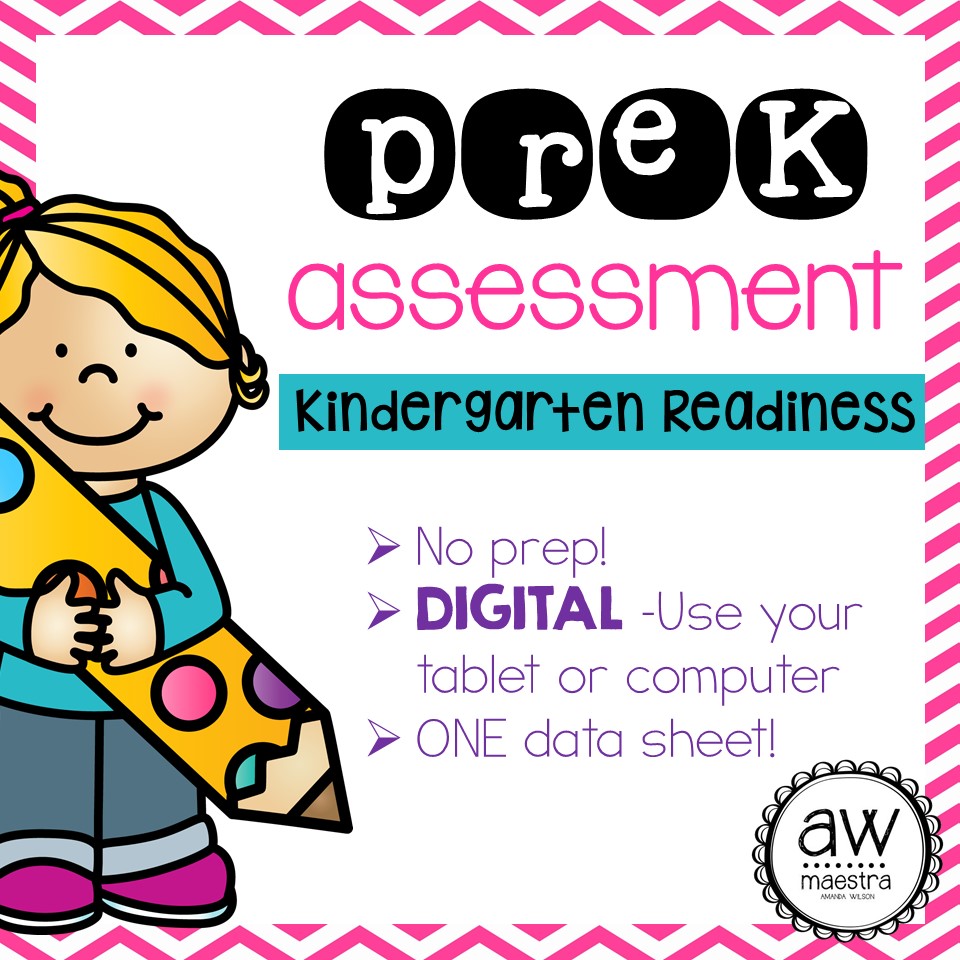
Pre-K Assessment for Kindergarten Readiness
A fun, engaging simple digital assessment of kindergarten readiness skills for pre-k students. Just download and go!
“Loved this to help prep my 4 year old for kindergarten!” – Pinkerton Classroom Inspiration and Resources
Pingback: Classroom Storage Hack: 1 Simple Trick - Maestra Mom
Pingback: How to Write Engaging Lesson Plans for Preschool - Maestra Mom