
Hip-hip Hooray! It’s time for centers in preschool!
I absolutely LOVE centers in preschool! Yay! Our favorite time of the day!
Centers are the backbone of preschool classroom learning. As a pre-k teacher, I couldn’t imagine a day without them. In my very scientific observations, there are SO many reasons why centers are essential:
- Kids learn by playing & investigating
- Students get to practice social skills in 1-on-1 interaction or small groups
- Little kids need a break from having to focus and listen
- Teacher needs a break from whole group instruction 😊
- Centers allow for differentiated learning
- Working in centers lets kids apply what they are learning in whole group instruction
- Centers encourage review, practice, and repetition of skills
- Centers are kid-focused, age appropriate, highly engaging, and fun!
But despite all of that, some teachers are still resistant to centers. Why? Because there is so much potential for, well, disaster if not implemented correctly, ha! So, let’s jump right in and make this easier…
In the ultimate guide to Centers in Preschool, we’ll cover:
- How many centers should I have in preschool?
- What centers to have in preschool?
- How do you run centers in preschool?
- How long does preschool center time last?
- How to organize centers in preschool
- What rules do you use for centers in preschool?
- How do you clean up preschool centers?
- When do you start centers in preschool?
- How frequently do you change out centers?

How Many Centers should I have in Preschool?
When I first started teaching, the standard answer was 3-4 students per center, but I soon discovered that is a horrible piece of advice. Why? Well, three kids is a recipe for fighting and hurt feelings. Someone is sure to be the odd-man out. But, four children squeezed into one small space and sharing materials is even worse!
As a bilingual teacher, I was introduced to the concept of bilingual pairs where students work together with one learning partner – just two kids to a center. It changed our whole way of doing preschool centers! Suddenly, there were almost no behavior issues. The squabbling and negative interactions decreased dramatically!
Two kids per center is definitely the way to go. Now, I only put three children in a center if I have an odd number of students in order to avoid someone being alone.
What Centers to have in Preschool
So, if you do the math of only two students per center, that means you need…yes! At least 10-11 centers for a class of 20-22 students. That may seem daunting, but it’s easier than you think!
But which centers should you have?
Here are the 10 Preschool Centers I recommend:
- Reading Center
- Writing Center
- Art & Fine Motor Skills
- Dramatic Play
- Building Center
- ABC Center
- Math Center
- Science
- Technology
- Sensory Play
- Teacher Small Group Instruction
Now let’s dive into each center!
1. Reading Center
- Design a comfortable reading nook with lots of books! Consider using pillows, a bean-bag, or kid-size comfy chairs to promote relaxing and lounging.
- Change the books out every few weeks according to your theme. Use your school library!
- Add technology to let students listen to books read aloud from Youtube or other audio books.
- Even though preschoolers are pre-readers, the point of this center is to help them fall in love with literature by exposing them to a wide variety of interesting books.
- Every classroom needs a comfy, cozy little library.
2. Writing Center
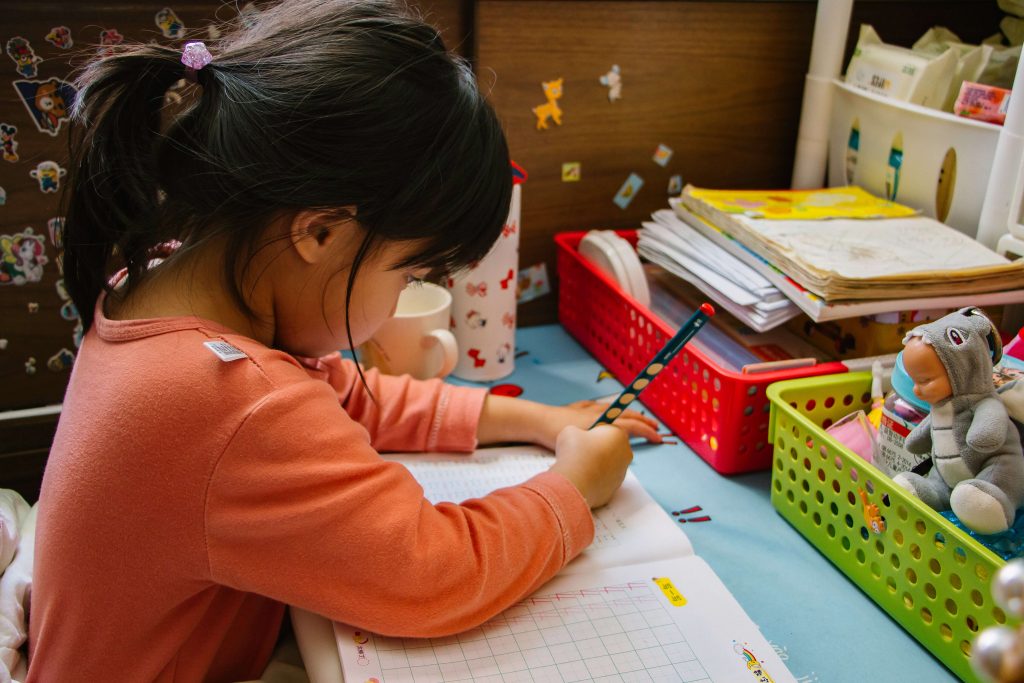
- Pencils, pens, markers, chalk, oh my! Change up this center by changing out the writing instruments from time to time.
- Provide lots of different paper and writing surfaces likes chalkboards, whiteboards, and laminated pages.
- Add vocab words by theme and ABC charts to copy. Kids also love to copy down the names of friends so keep a student list somewhere nearby!
- Let kids Write Around the Room by using a clipboard to copy all the words from the walls.
- Don’t forget thematic paper from my lesson plan bundles here.
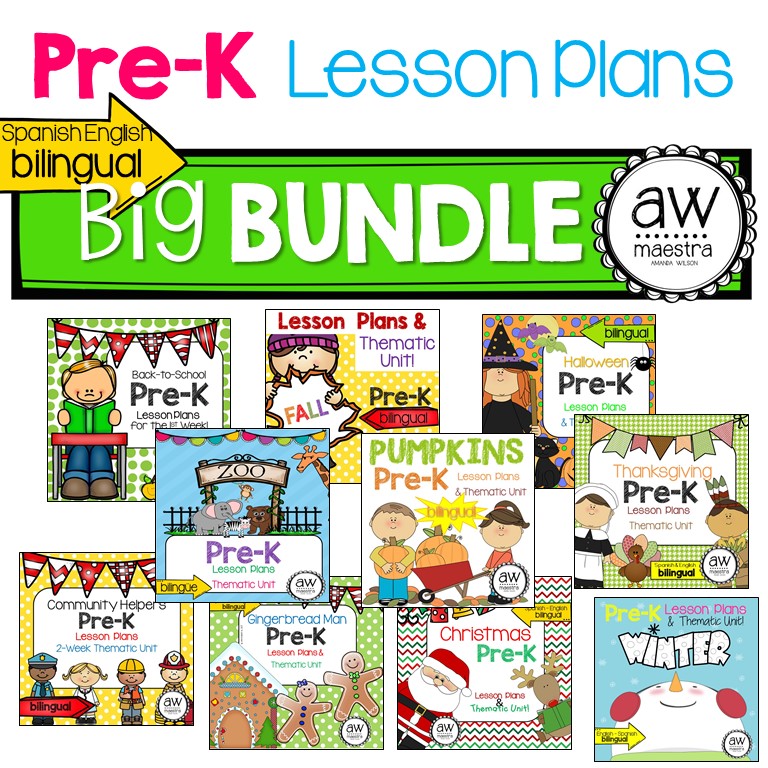
Pre-K Lesson Plans Bundle – English & Spanish
Units includes:
- Weekly Lesson Plans for 10 Units
- Sample Pre-K Schedule
- Suggested Read Aloud Book List
- Center Ideas
- Writing Activities
- Vocab Cards
- Number Cards
- Projects
- Recipes
- Games
- Poetry & Songs
- Mini-books
- Much, much more!
3. Art & Fine Motor Skills
- Art projects, crafts, playdough, cutting, lacing, gluing, finger paint, water-color paint, easel work, coloring, and lots of creative fun!
- Alternate between free art exploration like painting on the easel and teacher-modeled step-by-step art or craft projects to learn following directions.
- Not every day has to be messy art day! This is a great center to develop fine motor skills through activities like lacing beads onto pipe-cleaners or moving marbles with tongs or simply learning how to cut with scissors.
- Click here for fabulous FREE art center ideas!
- This center can easily be split into two groups of 2 if you need an extra center. For example, if you have an easel, assign to children to the easel and 2 more at a table doing a different art activity.
4. Dramatic Play
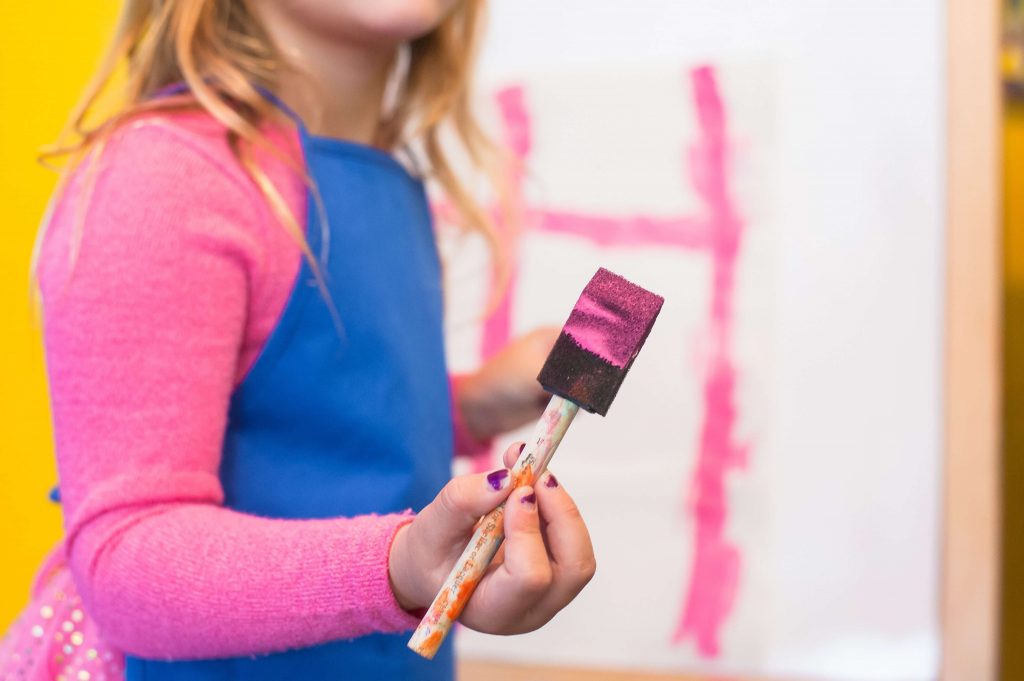
- Don’t fall into the trap of making this always a kitchen when there are endless opportunities for learning! Change it every few weeks according to theme.
- Integrate writing and reading into playing as much as possible.
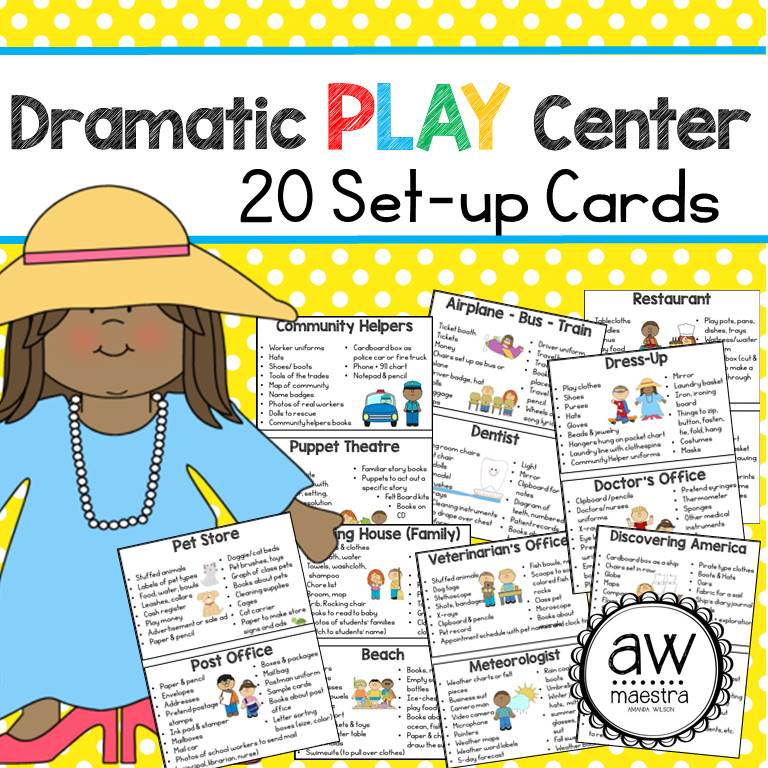
- Grab a copy of my Dramatic Play Center Cards for a whole bunch of inspirational, do-able ideas!
- Dramatic Play is one of the best centers to encourage practicing new vocabulary conversation, speaking and listening skills, and story-telling, which are all foundational concepts for young students learning to read and write.
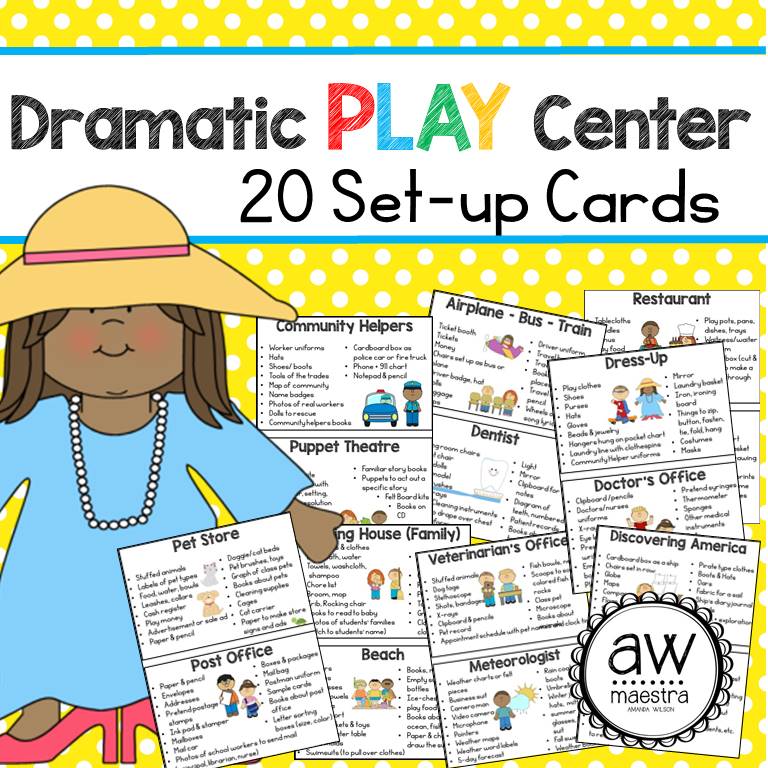
Dramatic Play Printables
With these 20+ Dramatic Play Cards, turn your dramatic play center into an airplane, grocery store, beach, post office, restaurant or much more!
“Helpful when putting together a new center with my class” – Elizabeth H.
5. Building Center
- Change out the materials in this center frequently! Kids love blocks….for a few weeks.
- Try Legos, Lincoln Logs, magnetic building tiles, gears, trains, PVC pipes, and more!
- Think of the building center as a STEM engineering center and focus on materials that allow kids to build, create, and problem solve. Endless possibilities!
6. ABC Center
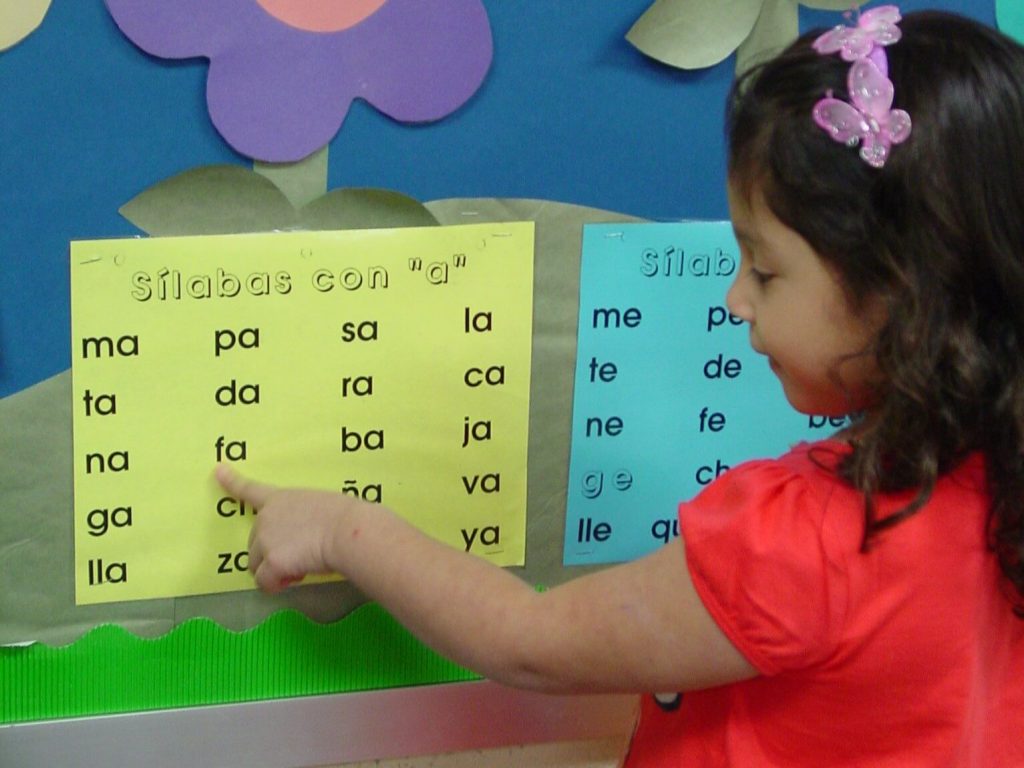
- Target phonics instruction, letter identification, and beginning sounds in this center.
- Fill your center with magnetic letters, letter cubes, ABC tiles, and alphabet cards.
- Later in the year, include activities to practice beginning sounds, syllable games, rhyming words activities. Not all at once, of course!
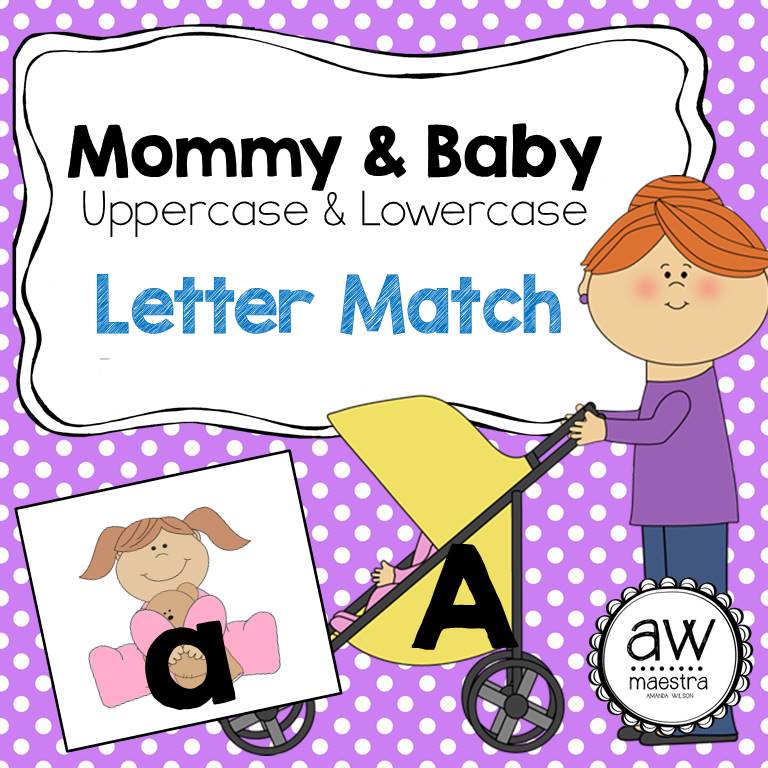
- Try this little game or this adorably fun uppercase-lowercase matching game.
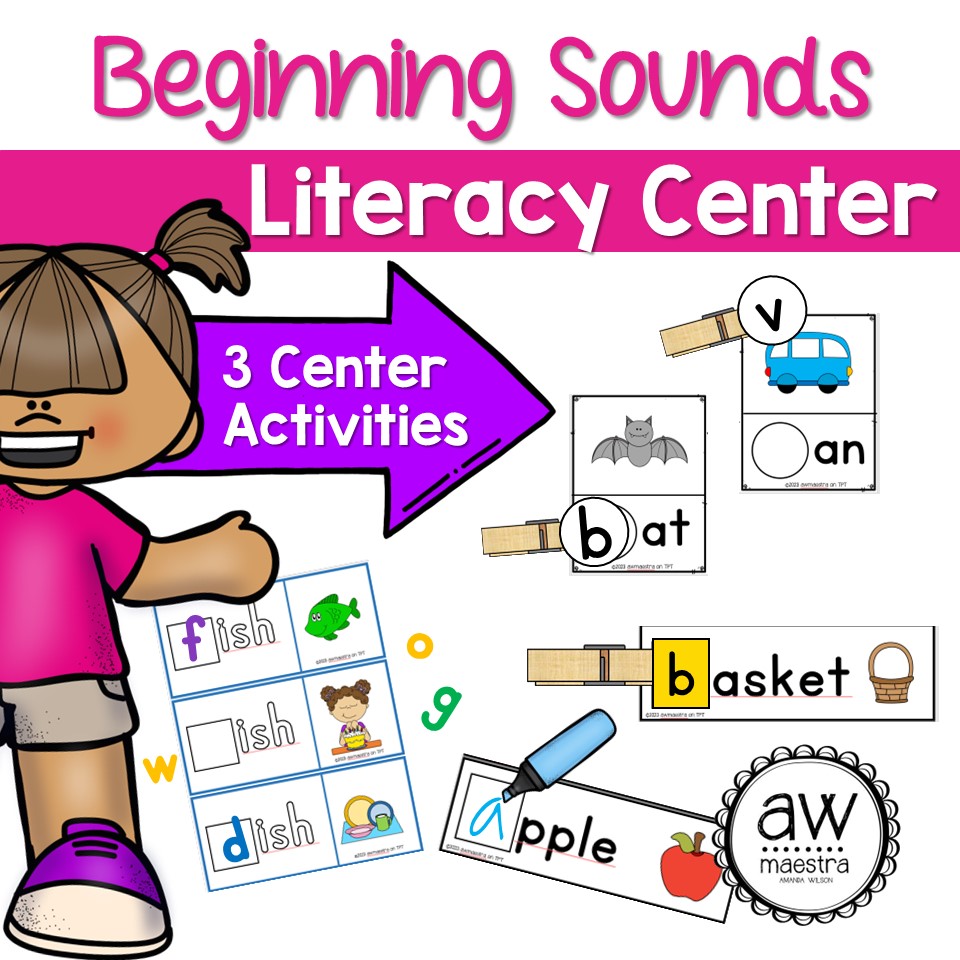
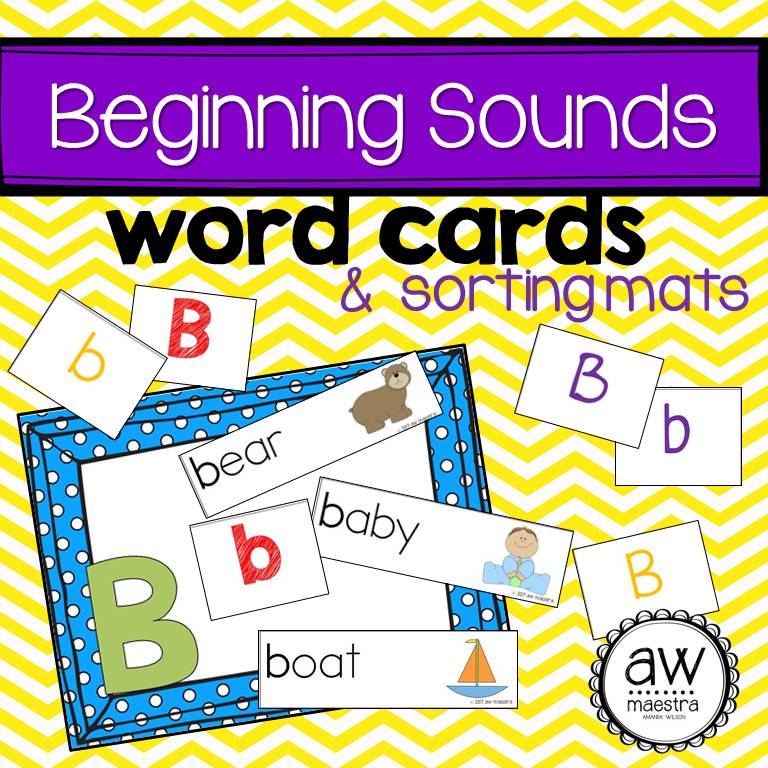
Beginning Sounds Literacy Center
⭐3 Activities targeting beginning sounds!
(1) a beginning sounds pocket chart activity
(2) a clip-card CVC initial sounds activity, and
(3) a magnetic letters word family activity
7. Math Center
- This is the place for anything related to numbers and counting!
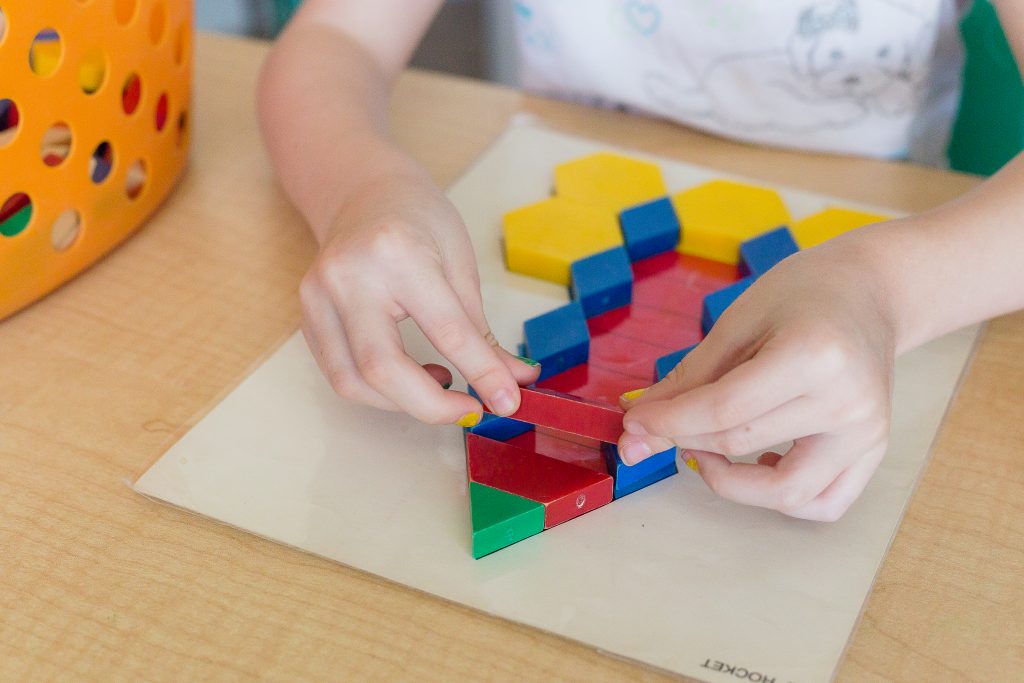
- Dice, dominoes, magnetic numbers, 10-frame games, counting activities, numeral recognition, shapes, pattern blocks, and much more!
- Keep it hands-on and engaging!
- Or check out even more math center ideas to get your wheels spinning!
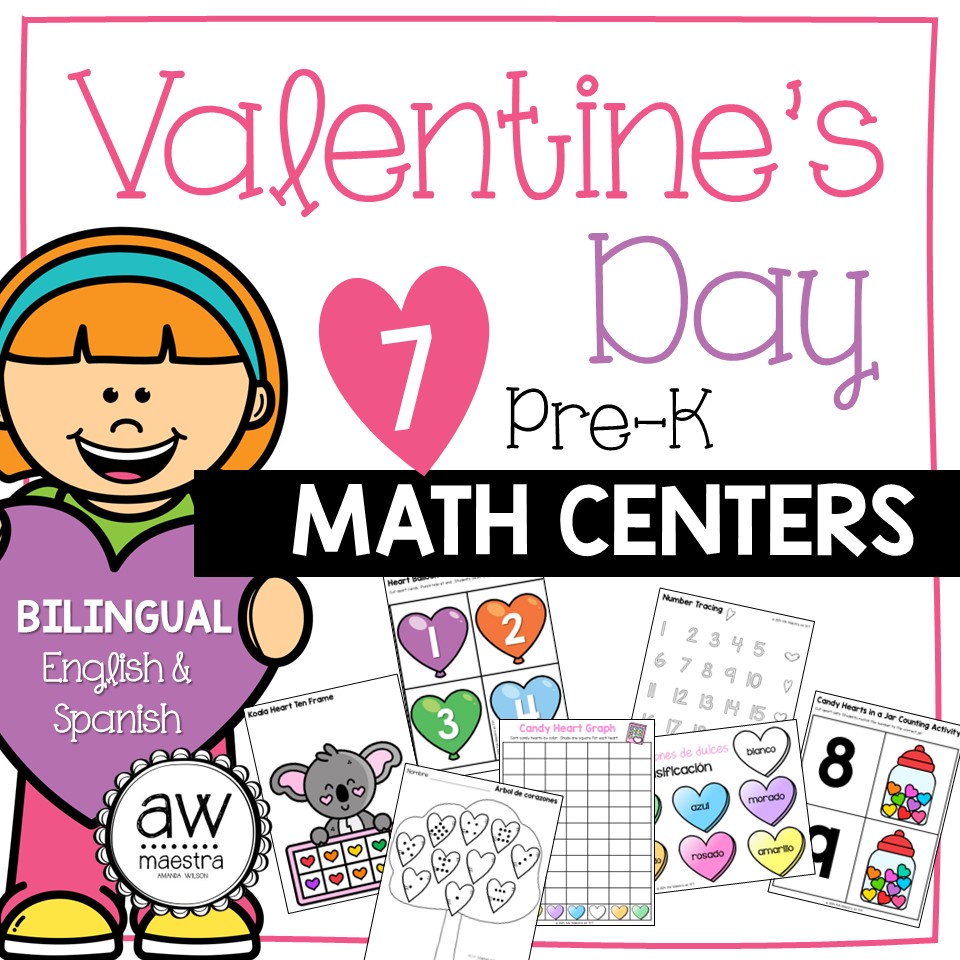
Preschool Math Centers
Seven bilingual heart-themed done-for-you math centers in Spanish and English for your preschool classroom! Cover patterning, sorting, graphing, numeral recognition, ten-frames, and counting to 20 with this fun and engaging set!
8. Science Center
- Fill your science center with thematic materials like pine-cones and mini pumpkins in the fall, ice-cubes in the winter.
- Play with slime. Draw and label flowers. Use magnifying glasses and magnetic wands. Study leaves. Create curiosity!
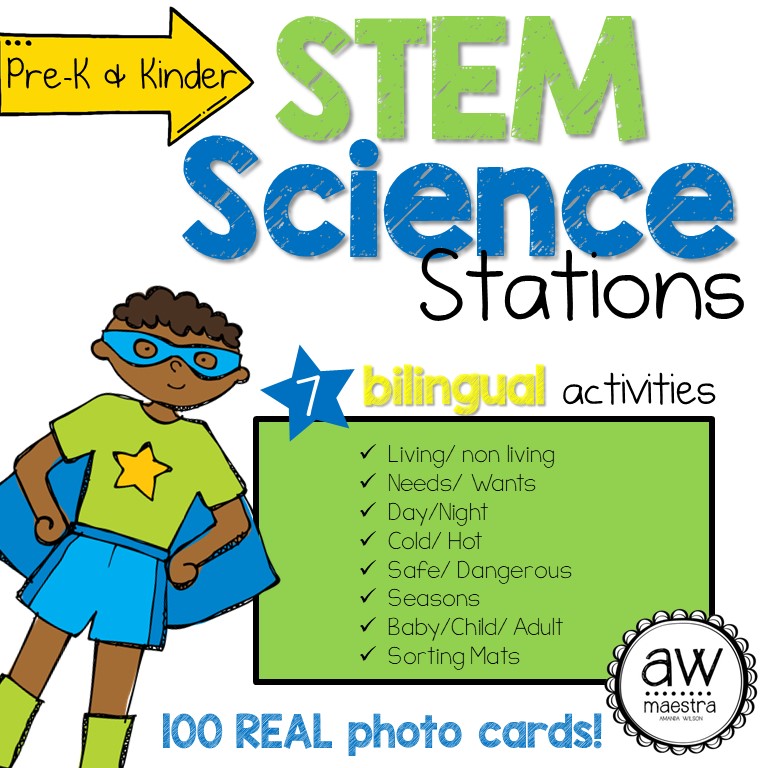
- Try out these amazing Science STEM sorting cards I designed especially for my pre-k science centers. We keep them in a file folder system to pull out according to theme. My kids love them – and so will yours!
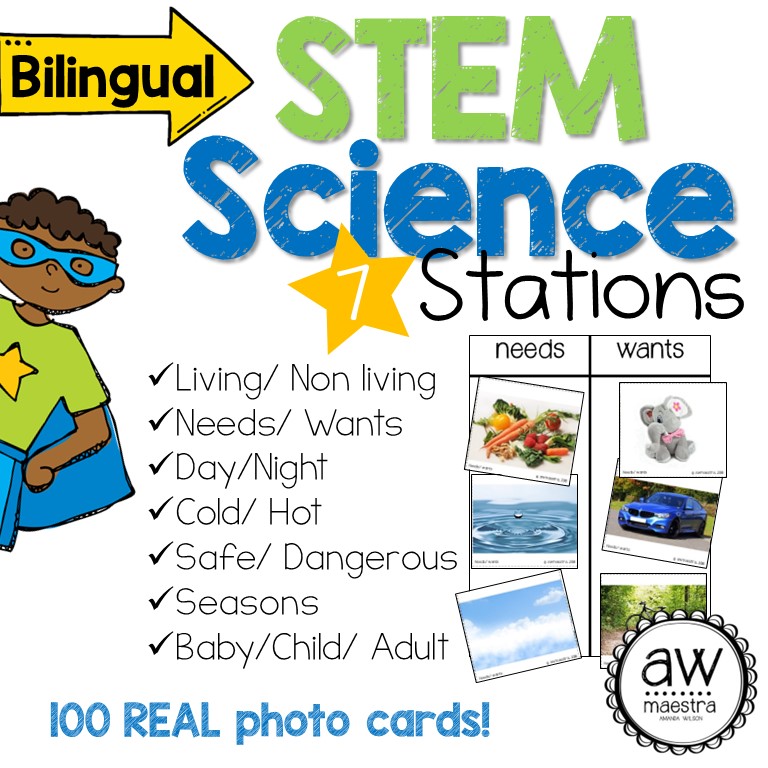
STEM Science Sorting Cards for Pre-K
Keep on hand 7 ready-to-go science sorting activities designed especially for preschool learners!
9. Technology
- This center will vary based on the tech you have available: tablets, computers, interactive white boards, or hand-held devices.
- If you need another center to house 4 kids, this can be a great place to do that as you can put 2 kids on computers and 2 on tablets or something similar.
- There are so many fabulous apps out there and since many may be purchased through your school district, I won’t recommend any specifics here.
A few of my free favorite simple internet-based learning programs for pre-k are:
- Starfall.com – The kids love this one! Great ABC songs and so much more!
- ABCya.com Fun, interactive educational games
- YouTube – You can create playlists of nursery rhymes and preschool learning songs. I especially love songs from Super Simple Songs. My students love to just sit and sing along! Builds wonderful vocabulary and language skills, especially for second-language learners!
- Cocomelon – ok, it’s not internet exactly, but this adorable streaming TV series on Netflix may just be my absolute favorite for early childhood learners.
10. Sensory Play
- Don’t limit sensory play to only sand or water, but that’s a great place to begin!
- Try washing the baby doll during your family unit or digging up and sorting buried plastic animals during your study of animals.
- The goal of this center is to introduce students to new textures, promote investigation and discovery which will help them problem solve and learn how to think!
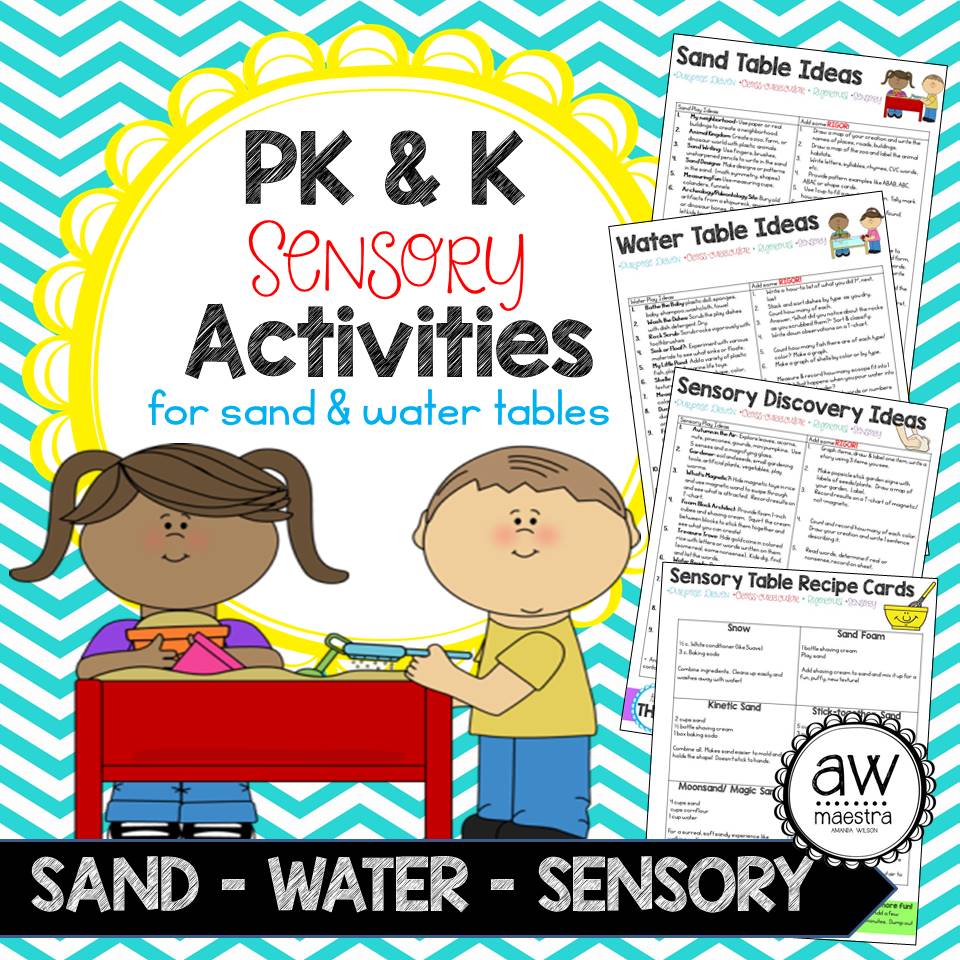
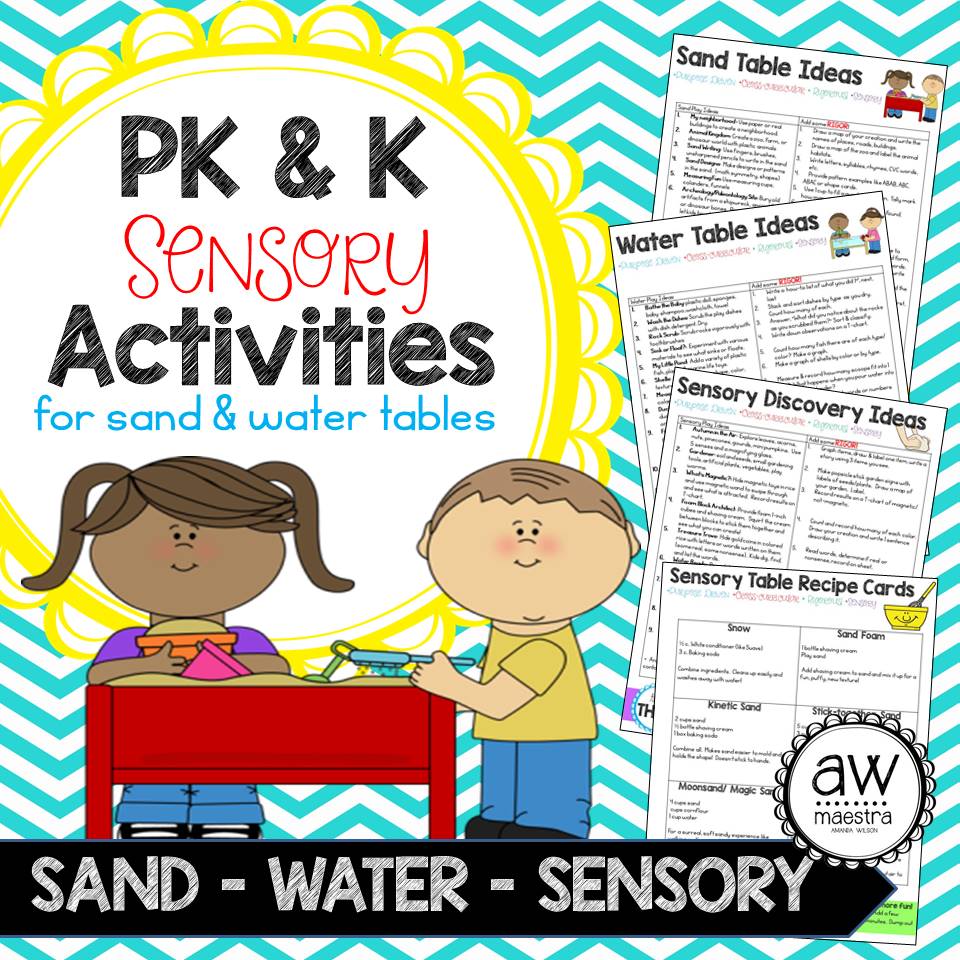
Sensory Freebie
Over 30 ideas for your sand & water table including engaging sensory experiences!
Each page includes ideas for what to put in your table as well as ways to add RIGOR and hold students accountable for their learning.
11. Teacher Small Group Instruction Time!
- During centers in preschool, YOU as the teacher can become one of the centers!
- Pull 2-4 students to meet with you on the rug or at the table. Use small groups to differentiate instruction based on student needs and target specific skills.
- This is when you introduce new concepts or model how to interact with new materials. Next week, place those same materials into the centers for independent and partner work.
- In my small groups, I often alternate between focusing on math lessons and literacy.
How do you run centers in preschool?
1. Assign Partners
First, assign each student a partner. The pairs should last at least all week long but can certainly last longer. I often change up my partners about once a month. We use a large pocket chart with student’s names and photos written on cards. It is quick and easy to move student pairs around in the chart!
2. Model
Second, teach students how to do all centers before implementing. Students tend to just make a mess or even destroy materials when they don’t know how to interact with them properly. Model what you expect for each center before allowing students to work there.
3. Teach the Rotation
Thirdly, decide on a center rotation and teach it to your students. I generally set up my centers all along the outside edges of my classroom, leaving the rug area and some tables for whole group activities. Then, students move in a logical order, for example, moving to the next center on the right, in a circle around the room. I decide on the center rotation instead of allowing the kids to choose (and fight over) their centers.
Students spend 10-15 minutes in one center (while I pull a small group for differentiated instruction), then I ring a little bell, and the partners move to the center to the right. I don’t ask the pairs to clean up the center or their materials before leaving since another pair of children will be continuing their play. Rotation is quick and quiet! But it must be taught and modeled.
How long does Preschool Center Time last?
Overall, centers in preschool should last between 45-60 minutes each day. Since students spend 10-15 minutes in each center, each pair may go to 4-5 centers each day. That means if you have 10-11 centers, kids will end up in each center roughly every other day.
This rotation schedule is wonderful because it exposes each child to each center systematically, eliminates fights, and eliminates the need for any complicated clip system or card system for organization. A big classroom management win!
>>> Download your FREE Bible Songs for Kids!
How do you organize centers in preschool?
- Label centers with signs & pictures
- Model how to use each center
- Teach the rotation
- Have a pocket chart showing student pairs
That’s it! Nothing fancy or complicated here! Simple is best.
What rules do you use for centers in preschool?
We only have one rule in addition to our simple five classroom rules.
Our extra center time rule is called The 12-inch Rule. Preschool kids don’t usually know what a ruler is yet, but they can easily learn! I hold up a ruler and we use it to talk about voice levels. When your friend’s head is only 12 inches away, you only need to use a soft, gentle 12-inch voice!
A fun touch is to put a plastic ruler in each center at the beginning of the year. It’s a great visual reminder and you’ll see the kids pick it up and practice whispering to each other just the perfect distance away from each other! This is a sure-fire way to keep the noise level to a gentle hum!
Classroom Rules Posters
Bright, interesting posters for our super simple 5 classroom rules:
1. We walk (FEET)
2. We speak quietly with permission (MOUTH)
3. We listen & follow instructions (EARS)
4. We stay inside of our own space (HANDS)
5. We are kind & caring to each other (HEART)
How do you clean up centers in preschool?
I allow about 5-10 minutes for center clean up. When we are ready, I ring the bell and start singing our classroom clean-up song. (I include the songs in my Back-to-School Pre-K Lesson Plans if you’re curious!)
You can also use a pre-recorded clean-up song like this one here, too. I’ve taught students that when it’s cleaning time, we all help! Each pair is responsible to clean the center they are in at that moment.
You can teach your kids to clean their center and then sit down in the center to show they are finished. Some teachers like this because it lets you do a fast walk around the room to inspect and see if all the materials got put away.
But, I’ve learned that some centers are cleaned up quickly (sometimes in a matter of seconds) while others take a bit longer (blocks, anyone?). So, I usually teach my class to clean their center completely, give your partner a high 5, then look around to see if you can help out another pair.
When your kids are all done cleaning and helping, you can teach them to go sit on the rug or go get their backpack, or whatever you need students to do next.
Another great idea is to have sing-along songs playing AFTER the cleanup song so students who have finished can go to the rug and join in a song. This will encourage the lagging children to hurry to clean so they can join in the fun, too!
When do you start centers in preschool?
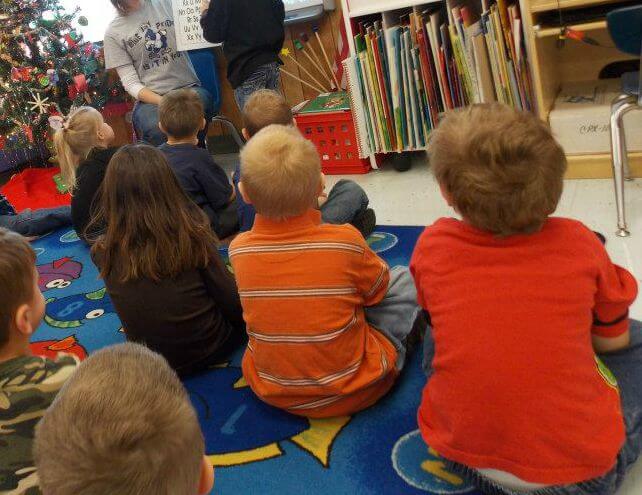
I introduce centers on the very first day of school!
The first week of school in pre-k or preschool is a super-important definitive time to teach classroom routine. Before students can do centers, they must be taught the routine, rotation, and exactly HOW to interact with materials and other kids in each center. Don’t just set them loose!
On the first day of school, you simply want students to understand the concept of centers and the simple concept of STAY IN YOUR CENTER – because they like to wander all over! During the first week, our center time is modified to be a shortened time (only about 30 minutes) and we start with only five centers intuitive to students:
- Dramatic Play
- Puzzles in the math center
- Reading center – books
- Blocks
- ABC Center
1st Week of Preschool Lesson Plans
“This has been very helpful in planning my lessons for the first week of school. I love the lessons for teaching the procedures!” – Janea S.
Yep, that means more than two kids per center, but that’s ok during the first week. They only stay in each center about 5 minutes to get a taste of it and learn how to rotate. As more centers are taught, fewer students will be in each center until we get down to two kids in each.
Don’t pull small groups the first week until students can rotate successfully and independently! Train, train, train! Wander around the centers as the kids explore and teach how to interact with materials and how to interact with new friends.
Your first week of centers will set the stage for successful classroom management the whole year long!
For step-by-step instructions on how to introduce centers and get them going, grab my Back-to-School First Week in Pre-K Lesson Plans. There, I go into more detail on how to implement centers the 1st week of school and break it down day by day exactly what you should teach and do.
>>> No storage space? Try my #1 Classroom Storage Hack to free up some space!
How frequently do you change out centers in preschool?
Don’t make the classic preschool teacher mistake of setting up awesome, engaging centers…and then leaving them the same all year long. When kids get bored, they will misbehave! Even the most amazing centers get boring after a few weeks!
Plus, if centers are not reviewing, reinforcing, or applying new concepts as you are teaching them then students are not getting what they need out of centers. Center time is not just wasted time, but valuable learning through play!
Preschool teachers should be using thematic planning and carefully written lesson plans weekly to target instruction for students. I include lesson plans in all of my thematic units for prek that you can tweak and use if you need help visualizing how to write lesson plans for preschool!
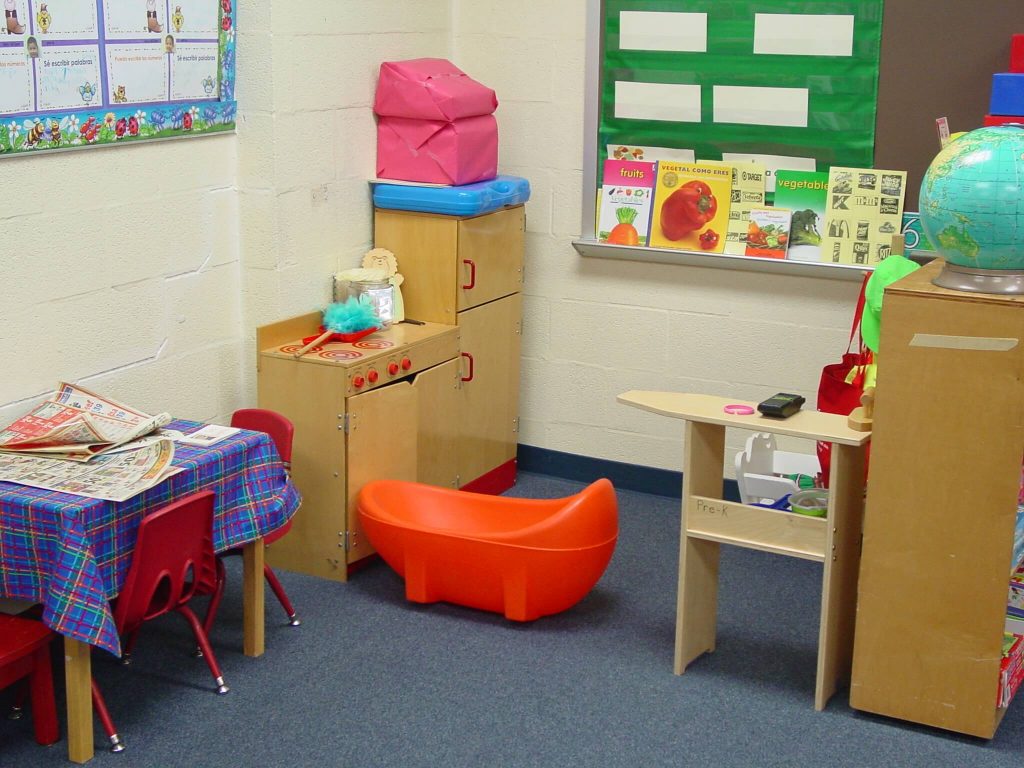
Some centers need to change more than others. The dramatic play center is a great place to change completely every few weeks based on your thematic unit. Instead of being a kitchen all year, why not a dentist’s office? Or a vet clinic, a restaurant, a zoo, or even Santa’s workshop?
Changing it up keeps kids interested and encourages them to practice new vocabulary and skills. Grab your set of Dramatic Play Quick Set-up Cards for year-long inspiration. Your kids will thank you!
In other centers, such as the ABC center or math center, I gradually rotate new materials in while leaving old materials. So, for example, if I wanted 4 math activities in the math center, one activity might be a new math game that we learned in small group instruction just last week. The other 3 materials may be from previous weeks or need minimal teaching, such as sorting plastic bears. The following week, I would phase in another new activity and remove one of the old ones.
Aim for 4-5 activities per center so students have choice based on interest but are not overwhelmed with too many options.
Centers in preschool are so much fun!
They are an absolutely essential chunk of your preschool day! And now you are ready to run them without hesitation. You’ve got this!
Happy teaching!